Introduction: The Bypass That Evaporates
The ownership arc so far was two questions. Who can say don’t ship? And have they ever actually stopped a line — on the record? Naming the seat and proving it can block are necessary. They are not the whole gate.
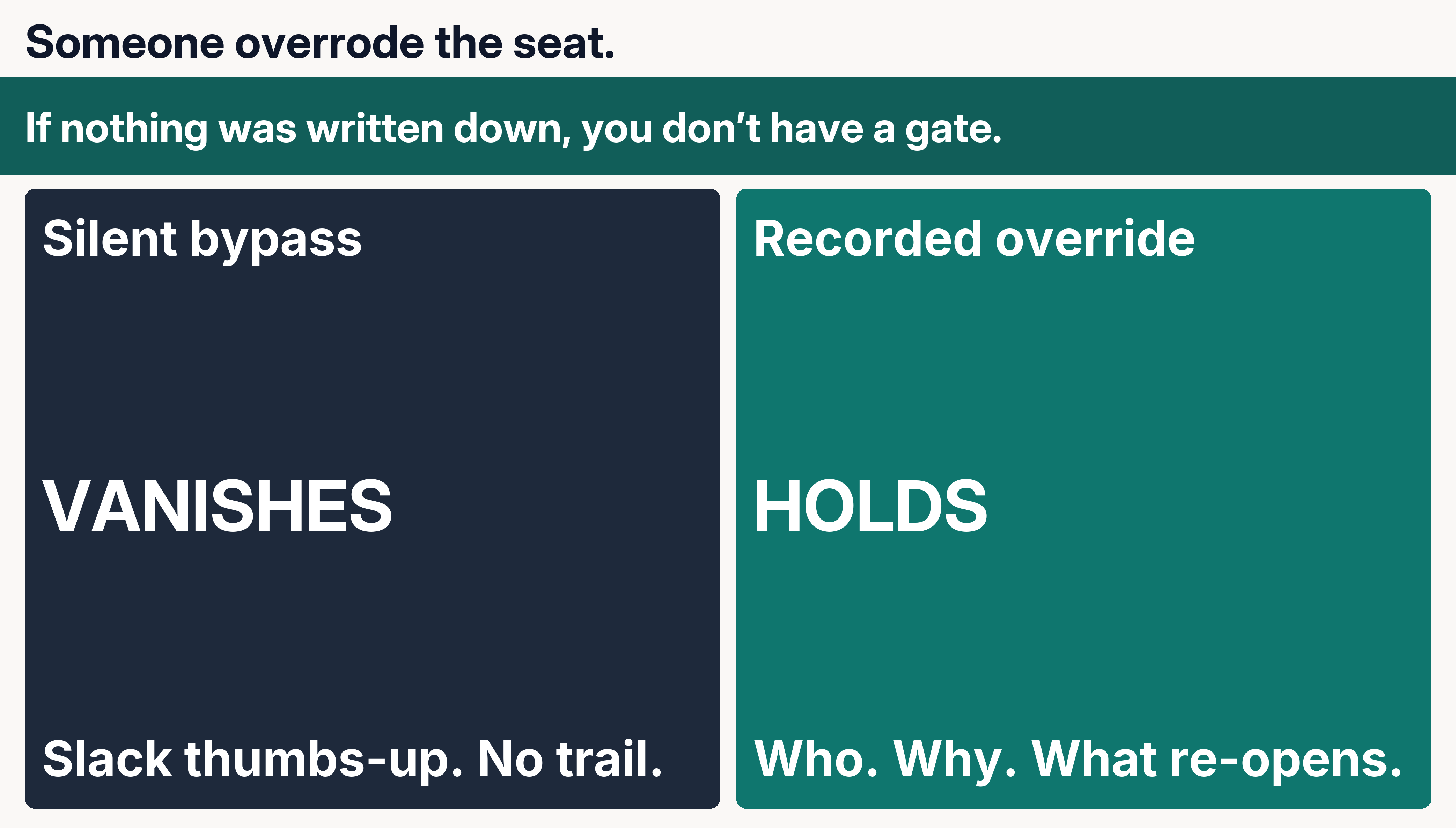
The next failure mode shows up under date pressure. The seat says no. Someone senior — or someone closer to the release — overrides. The merge goes through. The conversation lived in Slack, a hallway, or a thumbs-up on a PR comment. Next quarter, there is no trail: who overrode, why, and what was supposed to re-open the call.
An override without a record isn’t governance. It is how fail-closed becomes optional again — with better optics.
Why Silent Overrides Feel Practical
Silent bypass feels like adult judgment. The suite was flaky. The customer date was real. The named owner was “being careful.” Early on, a verbal override between two people who trust each other can be honest.
At fleet scale, silent overrides become the real policy. Every blocked path that ships anyway teaches the org that the seat is advisory. The next person under pressure copies the pattern. Observability still shows the traces. The decision record is empty — so still-trust has nothing to re-ask against.
AppSec already learned this: exception tickets exist because “just this once” without a log becomes “always.” Model-backed paths are still mostly running exceptions in chat.
What a Recorded Override Looks Like
Overrides will happen. The question is whether they leave a contract:
- Who. Named person who bypassed the seat — not “leadership.”
- Why. Plain-language reason tied to the path and the date — not a vibe.
- What was skipped. Which evidence failed or was missing.
- What re-opens. The condition that restores fail-closed — re-run, fix, or pull.
- Durable. Attached to the change, not buried in a disappearing thread.
That record is how a named seat stays real after the first political override. Without it, the org has proven the seat can be ignored.
What Does Not Count
- A Slack “LGTM, ship it” with no link to the path or the failed artifact
- “We’ll clean it up after the release”
- A force-merge with no exception note
- A retro that never names who overrode
- A dashboard that still shows green because the override never registered
Those habits can coexist with serious people and serious tooling. They still mean clearance is optional whenever the calendar gets loud.
What Changes for the Person Who Owns the Product
If you own a live model-backed path, stop after you can name the seat and show a block. Ask:
- When was the last override — and where is it written?
- Did it say what re-opens fail-closed, or only that shipping won?
- Would a non-author find that trail next quarter without asking around?
If the honest answer is “it was in Slack,” you have a bypass culture. You do not have governance.
The Executive Test
Ask one question: Show the last time someone overrode don’t-ship on a live path — who, why, and what was supposed to happen next.
If the room cannot produce the record, overrides are silent. Silent overrides empty the seat. An override without a record isn’t governance.
Simon Brightman
VP Product & AI executive with 20+ years leading data platform, agentic systems, and commercial transformation mandates across FinTech, GRC, and enterprise SaaS. Cambridge Master's graduate.
← Back to insights